
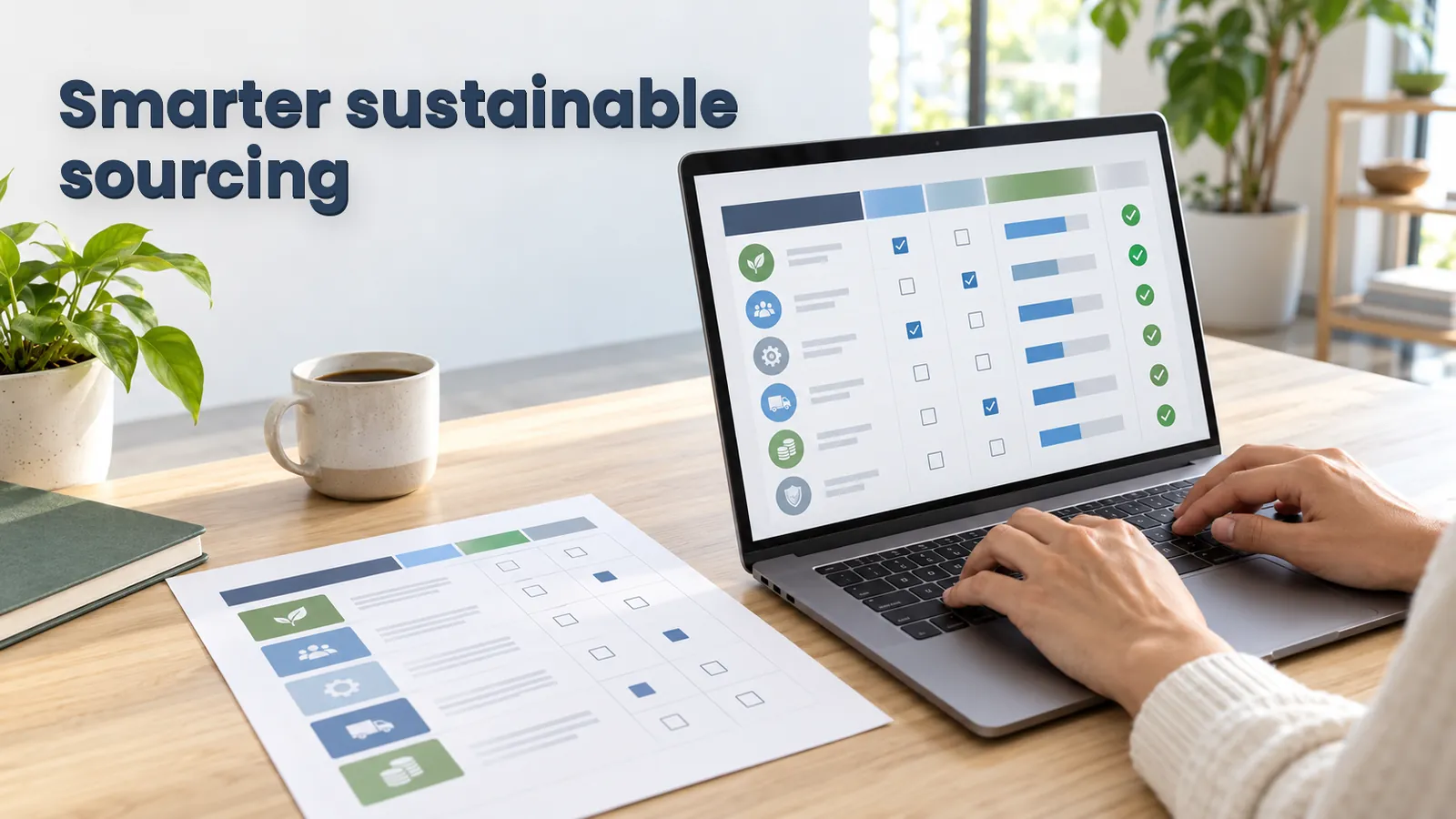
Most category strategies still treat sustainability as a compliance footnote, even though procurement teams now control the single largest lever on corporate emissions: purchased goods and services. A well-built sustainable procurement strategy embeds environmental criteria directly into category plans, supplier audits, and RFP evaluations instead of bolting them on after commercial terms are settled.
This guide explains how to do that in practice. It covers Scope 3 data collection, the regulatory floor set by the CSRD, CBAM, and California SB 253, supplier audit scorecards, and total cost of ownership modeling, with steps you can apply in your next sourcing cycle.
Key takeaways
- A sustainable procurement strategy integrates environmental criteria into category strategies, RFP scoring, and supplier scorecards from the start, not as an afterthought.
- Scope 3 emissions, meaning indirect value chain emissions, are the primary decarbonisation challenge, yet only 38 percent of businesses currently measure their Scope 3 footprint (IBM-commissioned survey, cited by EcoVadis, 2026).
- The EU Corporate Sustainability Reporting Directive (CSRD), the Carbon Border Adjustment Mechanism (CBAM), and California's SB 253 are converting voluntary disclosure into legal obligation.
- Total cost of ownership (TCO) models that price carbon, waste, and energy give buyers a defensible financial basis for green sourcing decisions.
- Professionals who master these methods are in demand, and a structured certification for supply chain management can formalize the skill set.
At a glance
- Key regulations: CSRD (EU), CBAM (EU), and California SB 253 (US), plus due diligence laws such as Germany's LkSG and the EU's CSDDD (EcoVadis, 2026).
- Measurement gap: Only 38 percent of businesses measure their Scope 3 footprint, even though Scope 3 emissions average 26 times a company's direct operational emissions (IBM-commissioned survey, cited by EcoVadis, 2026).
- Core tools: Supplier audit scorecards, carbon-adjusted TCO models, and RFP sustainability weighting set high enough to influence award decisions.
- Data maturity path: Spend-based estimates first, then activity-based data, then supplier-specific primary data.
- Skills required: Category management, carbon accounting basics, regulatory literacy, and supplier development.
What is a sustainable procurement strategy, and how does it differ from a policy?
A sustainable procurement strategy is a structured, category-level plan that embeds environmental, social, and governance (ESG) criteria into sourcing decisions, supplier selection, and contract management. It differs from a sustainable procurement policy, which is a static statement of principles. The strategy defines how categories, suppliers, and spend will actually change over time, and who is accountable.
In practice, the strategy answers four questions for each spend category. What environmental impact does this category create? Which suppliers drive that impact? What alternatives exist? How will buyers be measured on progress?
A responsible procurement strategy then cascades those answers into RFP templates, negotiation playbooks, and supplier development programs. The policy sits on the website. The strategy lives in the category plan. Whether an organization calls it a green procurement strategy or a sustainable sourcing strategy, the test is the same: does it change what gets bought, from whom, and on what terms?
This distinction matters because regulators and auditors increasingly ask for evidence of execution rather than intent. Under the CSRD, in-scope companies must report value chain impacts with audit-ready data, which turns procurement records, supplier contracts, and scorecards into disclosure documents (Comundo, 2026).
Public sector bodies show what documented execution looks like. The UK Department for Work and Pensions, for example, publishes its sustainable procurement strategy alongside supporting tools such as a risk assessment methodology and government buying standards, so that policy commitments map to specific commercial activity (UK Department for Work and Pensions, published strategy).
Why are CSRD, CBAM, and California SB 253 forcing the issue now?
Three regulatory regimes are converting sustainability from voluntary to mandatory. The CSRD requires in-scope companies operating in the EU to disclose value chain emissions using audit-ready data. CBAM prices the carbon embedded in carbon-intensive imports entering the EU. California's SB 253 requires large companies to publish emissions on a fixed timeline.
CBAM currently applies to imports of goods such as steel, cement, aluminium, and fertilizers. Because the mechanism attaches a carbon cost to embedded emissions at the border, embedded emissions become part of landed cost, which lands squarely on the procurement desk.
California's SB 253 requires public and private companies generating more than $1 billion in revenue to disclose Scope 1 emissions, which come from their own operations, and Scope 2 emissions, which come from purchased power, starting in 2026. Scope 3 disclosure follows in 2027 (Manufacturing Dive, 2026).
The practical consequence is that emissions data is becoming a commercial attribute of a supplier, like price or lead time. Packaging company Amcor, for example, is standardizing emissions data collection from its suppliers and downstream partners as it works toward a 32.5 percent Scope 3 reduction by 2033 against a 2022 baseline (Manufacturing Dive, 2026).
Due diligence laws add further pressure. Germany's Supply Chain Due Diligence Act (LkSG) and the EU's Corporate Sustainability Due Diligence Directive (CSDDD) require companies to monitor, audit, and verify impacts across the value chain, while EU measures such as the EUDR and ESPR raise the bar on product-level transparency (EcoVadis, 2026).

How do you measure scope 3 emissions in the supply chain?
Scope 3 emissions are the indirect greenhouse gas emissions generated across a company's value chain, including purchased goods and services, transportation, and product use. Measuring them starts with spend-based estimates and matures toward activity-based and supplier-specific primary data, which regulators increasingly treat as the credible standard.
"Scope 3 supply chain emissions are, on average, 26 times greater than a company's direct operational emissions." (IBM-commissioned survey, cited by EcoVadis, 2026)
That gap explains why purchased goods sit at the center of most decarbonisation programs. It also explains why estimation method matters. A practical data collection program climbs a three-rung ladder:
- Spend-based estimates. Apply industry average emission factors to each dollar or euro of category spend. Fast, but blunt.
- Activity-based data. Replace spend with physical quantities, such as kilowatt-hours of electricity, tonne-kilometers of freight, or kilograms of steel. More accurate, and it exposes reduction levers.
- Supplier-specific primary data. Collect measured emissions directly from suppliers, ideally verified by a third party. This is the tier assurance regimes are converging on.
Data quality is becoming a competitive differentiator in its own right. Companies with strong primary data, including supplier-verified emissions and sensor-based measurements, hold a transparency advantage over firms relying on spend-based proxies (Comundo, 2026).
There is also a caution for teams adopting AI-driven procurement tools. AI in procurement is only as trustworthy as the supplier data it runs on, and most of that data has never been independently verified (EcoVadis, 2026). Building the primary data foundation comes first.
To operationalize collection:
- Map spend categories by emissions intensity and regulatory exposure.
- Segment suppliers by strategic importance, then prioritize data requests accordingly.
- Issue standardized questionnaires requesting product carbon footprints and facility-level data.
- Verify responses through third-party assessments or audits.
- Feed results into supplier scorecards and TCO models so the data changes decisions.
What belongs on a supplier sustainability audit scorecard?
A supplier sustainability scorecard converts ESG expectations into measurable criteria that buyers can audit. Effective scorecards cover emissions reporting quality, energy and resource use, environmental management systems, regulatory compliance history, and corrective action performance, weighted to reflect the risk profile of each category.
A workable scorecard for a manufacturing category might include:
- Emissions disclosure: Does the supplier report Scope 1 and Scope 2 emissions, and can it provide product-level footprints for what you buy?
- Data verification: Is reported data assured by an independent third party?
- Reduction targets: Are targets documented and time-bound, as with Amcor's commitment to a 32.5 percent Scope 3 reduction by 2033 (Manufacturing Dive, 2026)?
- Management systems: Are certified environmental management systems, such as ISO 14001 processes, in place at relevant sites?
- Compliance history: Any violations or due diligence findings under regimes such as LkSG or CSDDD (EcoVadis, 2026)?
- Improvement performance: How quickly does the supplier close corrective actions from prior audits?
Here is a concrete example. A food and beverage company sourcing flexible packaging sets a gate: suppliers must disclose facility-level emissions to reach the shortlist. On the scorecard, verified primary data earns full marks, activity-based estimates earn partial credit, and spend-based proxies earn none. A supplier that scores below the threshold enters a structured development program with defined milestones and a fixed review window, and only repeat failure triggers phase-out. The scorecard thus functions as both a selection tool and a supplier development instrument.

How do you embed sustainability into category strategies and RFP evaluations?
Embedding sustainability into an RFP means translating the category strategy into scored criteria, minimum thresholds, and contractual clauses before bids are opened. Sustainability should appear in three places: pre-qualification gates, weighted evaluation criteria, and contract schedules that make data sharing and improvement targets enforceable.
A step-by-step sequence that works in practice:
- Set category-specific ambitions. Recycled content for packaging, logistics emissions for freight, energy efficiency for equipment. Generic ESG language invites generic bids.
- Add pre-qualification gates. Require emissions disclosure and acceptance of the supplier code of conduct before a bid is scored.
- Weight sustainability in the evaluation model. The weighting must be high enough to change award outcomes, and the RFP should state exactly what evidence earns points.
- Request lifecycle data. Ask for product carbon footprints where methodologies exist, and state the preferred calculation standard.
- Write it into the contract. Include annual data submission, audit rights, improvement targets, and CBAM-relevant emissions data for affected imports.
This is where the category strategy earns its keep. If the category plan says emissions intensity will fall, the RFP weighting, the scorecard, and the contract clauses are the mechanisms that make it fall. Sustainable procurement examples from regulated industries, from hospital group purchasing to government frameworks, follow this same gate, score, and contract pattern, because auditors can trace it end to end.
How does total cost of ownership support green sourcing decisions?
Total cost of ownership (TCO) is a costing method that captures the full lifecycle cost of a purchase, including acquisition, energy, logistics, waste, compliance, and end-of-life disposal. A carbon-adjusted TCO adds the cost of embedded emissions, so greener options can win on financial merit rather than values alone.
A carbon-adjusted TCO model typically layers:
- Purchase price and payment terms.
- Energy and operating costs across the asset or product lifecycle.
- Logistics emissions costs, including fuel-linked freight exposure.
- Carbon compliance costs, such as CBAM certificates on affected imports.
- Waste, packaging, and end-of-life costs.
- Risk costs, including supply disruption exposure from climate-vulnerable inputs.
Consider an EU buyer comparing two steel suppliers. Supplier A offers a lower ex-works price but higher embedded emissions. Supplier B costs more per tonne but carries lower embedded emissions, and therefore lower CBAM certificate costs at the border. Once the carbon cost is priced into landed cost, Supplier B can win on TCO even while losing on price. That is the moment a sustainable sourcing strategy stops being a values statement and becomes arithmetic.
Statistical TCO modeling is a standard part of advanced supply chain training, which is one reason practitioners who can build these models are increasingly the ones asked to lead category strategy.
What this means for you
If you are a procurement specialist or supply chain professional, this shift changes your job description in concrete ways:
- Audit your category plans. Check whether each one names an environmental impact, the suppliers that drive it, and the mechanism that will change it.
- Learn Scope 3 fundamentals. You do not need to become a carbon accountant, but you do need to challenge data quality and explain the three-rung ladder to stakeholders.
- Build a scorecard template. Start with the six criteria above and adapt the weightings to your highest-risk category.
- Practice carbon-adjusted TCO. Run one live sourcing event through the model and compare the result against the price-only answer.
- Formalize the skill set. Employers and clients increasingly look for verified competence, and green supply chain management now sits inside mainstream certification curricula rather than at the fringe.
Organizations that bring in supply chain management consulting services for transformation projects still need internal champions who can run scorecards, interpret emissions data, and negotiate sustainability clauses after the consultants leave. That internal capability is where individual careers are being built.
How do you build the skills to lead sustainable procurement?
The competency stack spans category management, carbon accounting basics, regulatory literacy, and supplier development. Few professionals arrive with all four, which is why structured, self-paced learning has become the common route. IIPMR's supply chain curriculum, for example, covers green supply chain management and carbon footprint reduction through sustainable procurement and logistics, alongside strategic sourcing, statistical total cost of ownership tools, and contract strategy (IIPMR course modules).
A certification in supply chain management online lets working professionals build this stack without leaving their roles. The Certified Supply Chain Associate (CSCA) program covers 116 modules over 80 hours of self-paced study, with instructor support, exam, and certification included (IIPMR certification page). Procurement-focused professionals can also look at the Certified Procurement Professional (CPP) certification, which goes deeper into sourcing and supplier management.
For professionals earlier in the journey, a certification for supply chain management signals verified competence in exactly the areas this guide covers: category strategy, TCO, and supplier evaluation. For experienced practitioners, the advanced levels add depth in network design and risk, both of which now carry sustainability implications.
Explore IIPMR certification courses in supply chain management to compare the three levels and current enrolment incentives.
FAQs
What is sustainable procurement?
Sustainable procurement is the practice of integrating environmental, social, and governance criteria into purchasing decisions alongside price, quality, and delivery. It covers everything from supplier selection and contract terms to lifecycle costing and end-of-life disposal.
What is the difference between Scope 1, Scope 2, and Scope 3 emissions?
Scope 1 covers direct emissions from sources a company owns or controls, Scope 2 covers emissions from purchased electricity and energy, and Scope 3 covers all other indirect emissions across the value chain. For most companies, Scope 3 is the largest category, averaging 26 times direct operational emissions (IBM-commissioned survey, cited by EcoVadis, 2026).
Which companies must comply with California SB 253?
Public and private companies generating more than $1 billion in revenue and doing business in California fall under SB 253. They must disclose Scope 1 and Scope 2 emissions starting in 2026, with Scope 3 disclosure following in 2027 (Manufacturing Dive, 2026).
How much weight should sustainability carry in an RFP evaluation?
There is no universal standard, and the right figure depends on category risk and regulatory exposure. The practical test is whether the weighting is high enough to change an award outcome, and whether the RFP tells bidders exactly what evidence earns the points.
Is a sustainable procurement policy enough for CSRD compliance?
No. The CSRD's assurance requirements demand audit-ready data on value chain impacts, which means companies must show executed activity such as supplier contracts, emissions data, and scorecards, not just stated intent (Comundo, 2026).